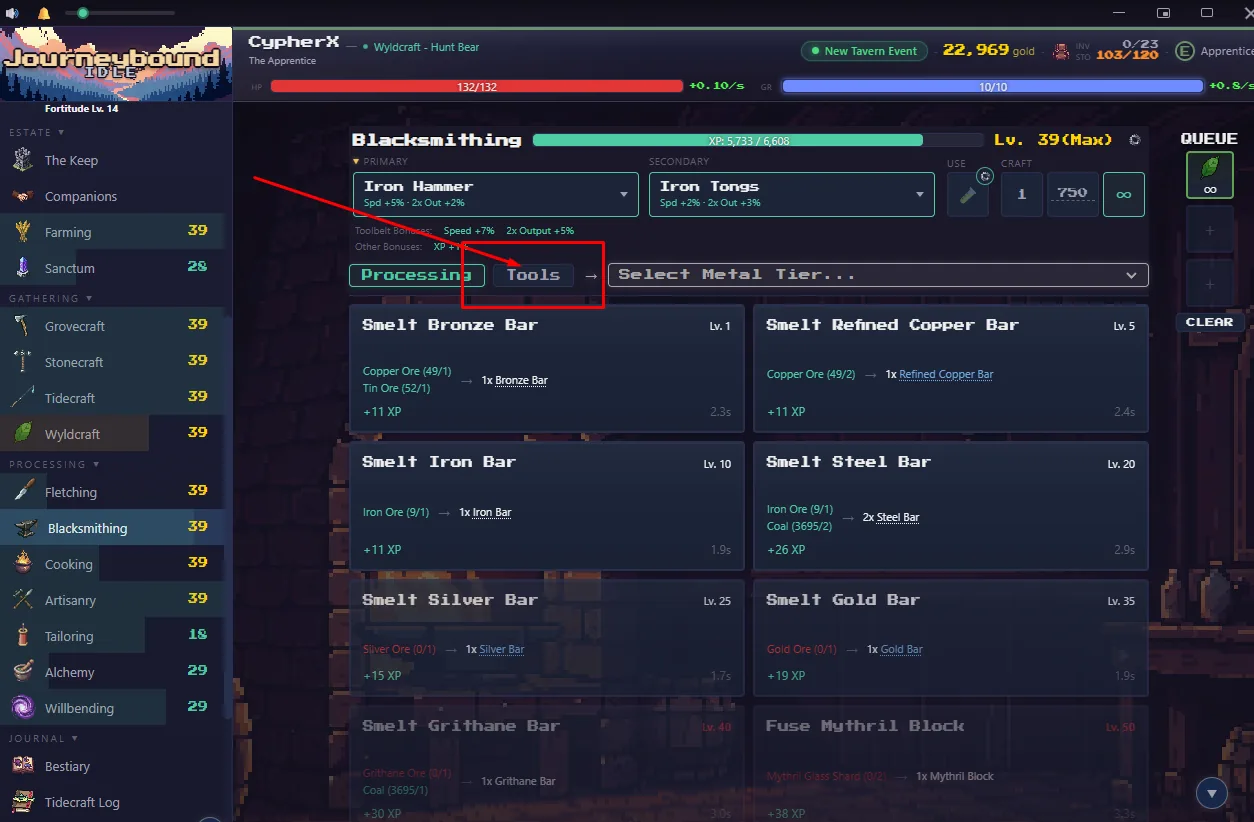
Thirteen skills in Journeybound Idle take tools, and almost none of them make their own. The tool for a skill is usually crafted by a different skill entirely, which is what makes tracking one down awkward: you know the tool you want, but not which crafting menu it is hiding in.
That is the whole problem this page solves. Below is every skill’s primary and secondary tool, and which skill actually produces it.
Finding a tool in the interface
The path is always the same three steps, and it reads backwards from what you might expect — you start from the skill that makes the tool, not the skill that uses it.
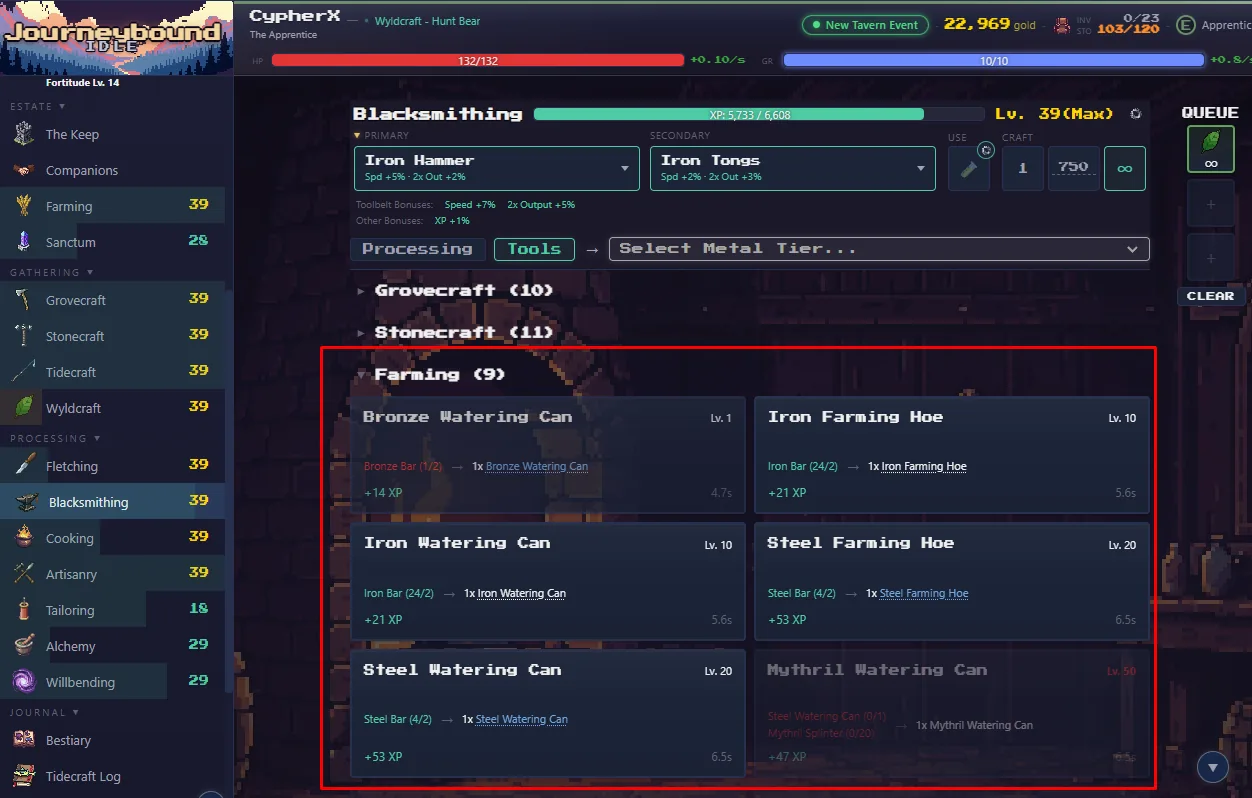
Pick the crafting skill in the sidebar. If you are after a farming hoe, that means clicking Blacksmithing, not Farming.

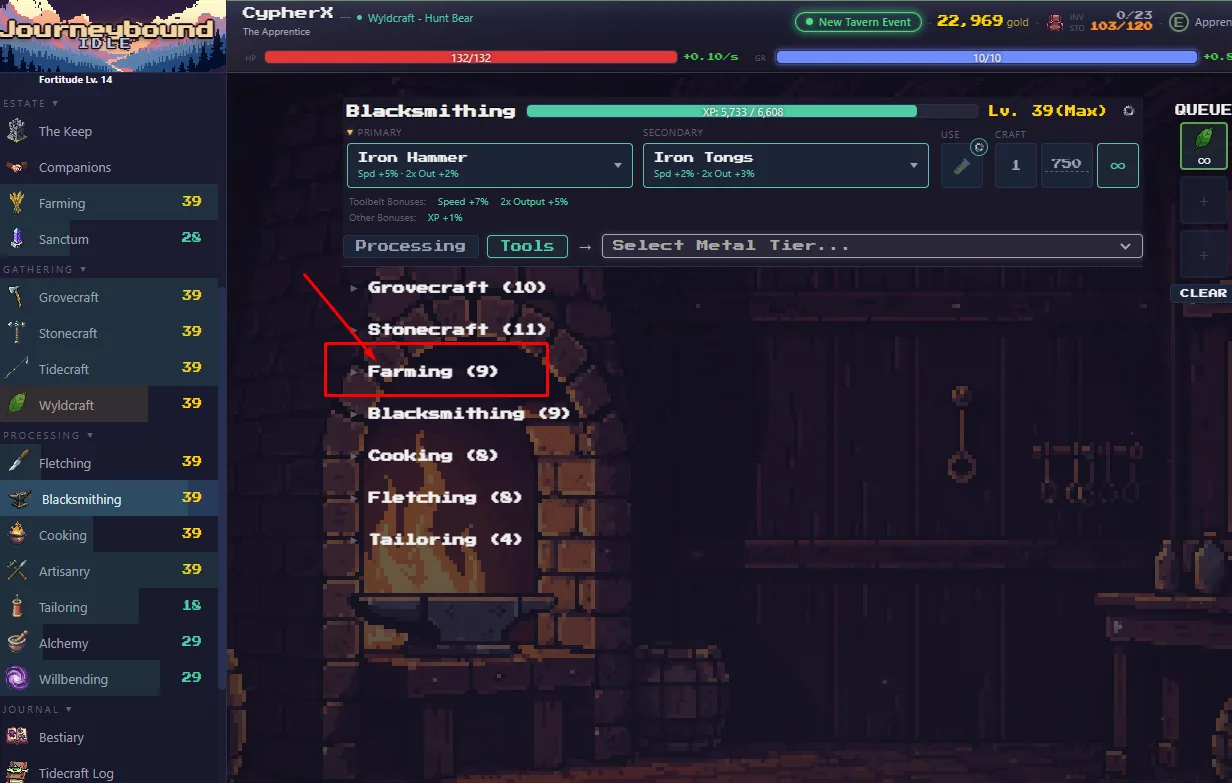
Inside that skill, open its Tools section.
Then choose the skill you want the tool for. The tools you are looking for are listed there, and the same path works for all skills.

Every skill’s tools
Two skills can also be reached at level 1 by a cheaper route, and one tool comes from a shop rather than a bench; both are noted under the table.
| Skill | Primary tool | Crafted by | Secondary tool | Crafted by |
|---|---|---|---|---|
| Farming | Farming Hoe | Blacksmithing | Watering Can | Blacksmithing |
| Sanctum | Incense Burner | Artisanry | Prayer Beads | Artisanry |
| Grovecraft | Hatchet | Blacksmithing | Saw | Blacksmithing |
| Stonecraft | Pickaxe | Blacksmithing | Chisel | Blacksmithing |
| Tidecraft | Fishing Rod | Fletching | Tackle Box | Artisanry |
| Wyldcraft | Gathering Gloves | Tailoring | Wyldcraft Kit or Snare Kit | Artisanry |
| Fletching | Fletching Knife | Blacksmithing | Fletching Jig | Blacksmithing |
| Blacksmithing | Hammer | Blacksmithing | Tongs | Blacksmithing |
| Cooking | Knife | Blacksmithing | Skillet | Blacksmithing |
| Artisanry | Artisanry Kit | Artisanry | Measuring Kit | Artisanry |
| Tailoring | Sewing Kit | Artisanry | Cutting Shears | Artisanry |
| Alchemy | Mortar | Artisanry | Distillation Flask | Artisanry |
| Willbending | Focus Crystal | Artisanry | Binding Ring | Artisanry |
There is a Wooden Farming Hoe available from Fletching, but only one, and only for level 1 — the Blacksmithing hoe is the real primary. Fletchers Remembrance is sold in the Guild shop rather than crafted, and appears in the secondary tool list without a crafting path attached.
Two skills make nearly everything
Read down the crafted-by columns and the pattern is hard to miss. Blacksmithing and Artisanry between them cover 11 of the 13 primary tools and all 13 secondaries.
Blacksmithing handles six primaries and six secondaries — the heavier, edged things: hoe, hatchet, pickaxe, fletching knife, hammer, cooking knife, and their partners. Artisanry handles five primaries and seven secondaries — the finer equipment: incense burner, kits, mortar, focus crystal.
Only two skills break the pattern, and both take their primary from an unexpected place. Tidecraft’s Fishing Rod comes from Fletching, and Wyldcraft’s Gathering Gloves come from Tailoring. Neither of those skills makes anything else on the list.
The practical consequence: if you want to supply your own tools rather than buy them, Blacksmithing and Artisanry are the two to level. Adding Fletching and Tailoring closes the remaining gap, and nothing else on the list produces a tool at all.
Willbending covers eight secondaries at level 65
Once Willbending reaches level 65 it becomes an alternative source for eight of the thirteen secondary tools: the Saw, Chisel, Tackle Box, Fletching Jig, Tongs, Skillet, Cutting Shears and Distillation Flask.
It does not replace the original maker — those tools are still available from Blacksmithing or Artisanry as before — it is a second route to the same item, useful if Willbending is already high and you would rather not level a crafting skill you have no other use for.
The five it does not cover are the Watering Can, Prayer Beads, the Wyldcraft and Snare Kits, the Measuring Kit, and Willbending’s own Binding Ring.