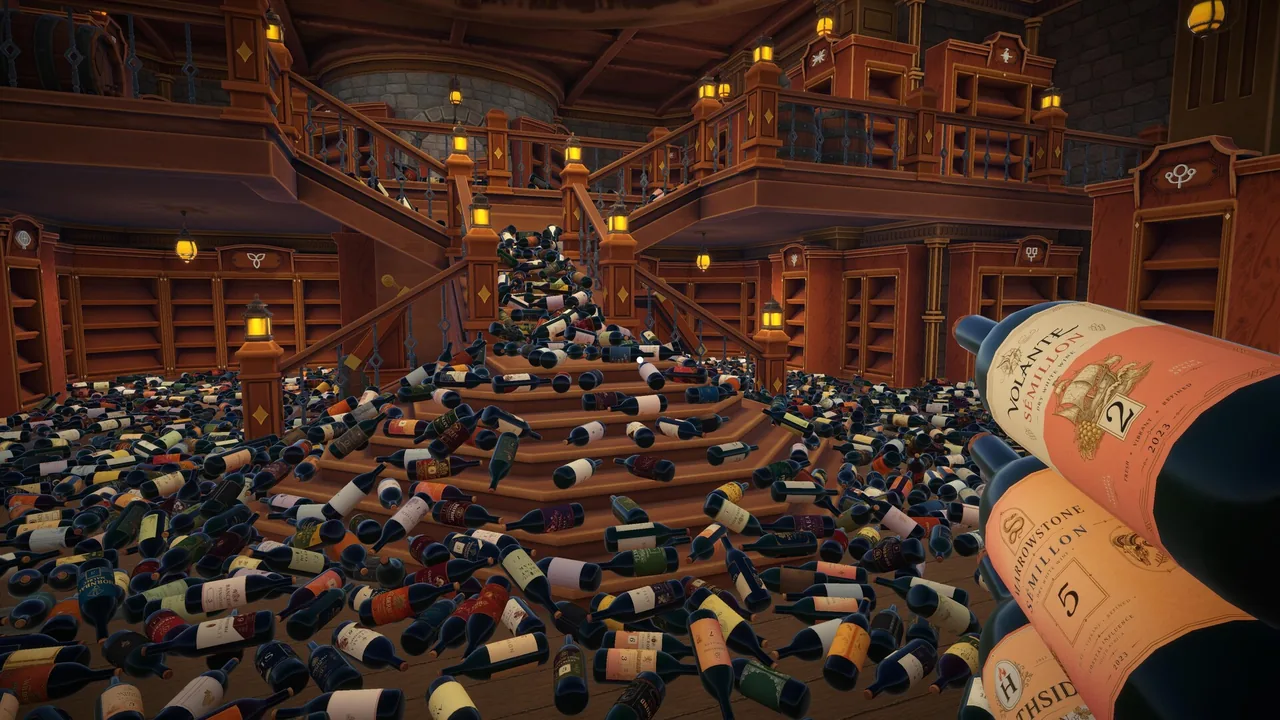
Cellar Keeper’s thirty varietals are colour-coded on their labels, and once you know the code you can sort a shelf without reading a single bottle. The catch is that the colours are a spectrum rather than thirty distinct hues, and several pairs sit close enough together to cost you real time.
An alphabetical list is the wrong shape for that job. When you are holding a bottle you do not know the varietal yet — the colour is the thing you have. So this is grouped by what you are actually looking at.
Greens
Four varietals are green, and telling them apart is a question of how bright.
- Pinot Noir — bright emerald, and almost always unmistakably so. The one exception is the Bancroft bottle, which is pastel green, and even that carries an emerald stripe along the bottom of its label.
- Muscat — green with an olive tinge. Less vibrant than pinot noir, though the gap is often narrow.
- Touriga Nacional — light green across a fairly wide spread of shades.
- Chardonnay — pastel green too, but over a narrower range than touriga nacional.
Blues
- Pinot Grigio — midnight blue, and much the darkest of the three.
- Malbec — vibrant blues in the middle of the range.
- Okuzgozu — pale powder blue almost without exception. Ironbound’s okuzgozu breaks it with a brighter sea blue.
Purples and pinks
- Shiraz — bright purple, the most saturated of this group.
- Grenache — pastel purple.
- Carmenere — pale lilac, sometimes drifting toward pink.
- Pinotage — pastel pink.
Reds
- Tempranillo — vibrant reds anywhere from ruby to maroon.
- Strawberry — two-toned, both tones being different shades of red.
- Pomegranate — red and white, in proportions that vary bottle to bottle.
Oranges and peaches
This is the busiest part of the spectrum and where most of the mistakes happen.
- Sangiovese — bright orange, usually the more vivid of the two oranges.
- Primitivo — russet orange, frequently leaning red.
- Cherry — bright two-toned pink and orange.
- Semillon — peach, and often two-toned itself, pairing a pinker peach with an oranger one.
- Glera — pastel peach, noticeably lighter than semillon.
Yellows, browns and neutrals
- Cabernet Sauvignon — yellow, from pastel through to vibrant.
- Riesling — brown.
- Bogazkere — deep mahogany.
- Palomino — grey, often with a smoky blue cast to it.
- Sauvignon Blanc — dark grey through to black, the darkest label in the cellar.
Whites
- Chenin Blanc — white.
- Pinot Meunier — white.
That is the whole distinction, and it is not a reliable one. Chenin blanc may run slightly more cream than pinot meunier, but it is not a difference worth betting a sorting run on.
Two-toned, and the wildcard
Three varietals are defined by being two-toned rather than by a colour, which makes them a category of their own.
- Blackberry — a jewel tone paired with either cream or gold. One of the least consistent varietals in the game.
- Blueberry — the same scheme, though its jewel tone is commonly blue.
- Mead — usually green with cream or green with gold. Sunbliss is the exception, pairing cream with gold and no green at all.
And then there is Merlot, which has no code. Merlot labels come in essentially any colour, so it is the one varietal you cannot identify this way at all. If a bottle refuses to fit anywhere above, merlot is the reason.
The pairs that will cost you time
Eight pairs are close enough to confuse, and knowing which ones in advance is most of the value here.
| These two | How to separate them |
|---|---|
| Blackberry and blueberry | Nearly the same scheme; blueberry’s jewel tone is usually blue |
| Chenin blanc and pinot meunier | Both white; chenin blanc may be slightly creamier, but it is not dependable |
| Carmenere and grenache | Grenache is generally paler and less saturated |
| Muscat and pinot noir | Muscat is the less vibrant green, though often only just |
| Primitivo and sangiovese | Sangiovese is usually, but not always, the more vibrant orange |
| Cherry and semillon | Both bright two-toned pink and orange |
| Glera and semillon | Semillon is the darker peach; glera stays pastel |
| Chardonnay and touriga nacional | Both pastel green; chardonnay covers a narrower range |
Blackberry and blueberry are the worst of these, because both are inconsistent bottle to bottle rather than merely similar to each other. The rest reward a second look; those two sometimes just have to be read.